
TL;DR
- Indian businesses lose real revenue when foreign card payments fail at checkout, and most of those declines trace back to weak authentication, cautious issuing banks, and a checkout that ignores the buyer's context.
- To accept international card payments in India you need a cross-border payment gateway that authorises foreign cards well, handles 3DS authentication, and settles to your Indian bank account with the paperwork (FIRA) sorted.
- The metric that decides whether this works is Payment Success Rate (PSR), the share of attempted payments that actually go through. PayGlocal markets PSR up to 96%, with real merchants moving from roughly 75% to 95%.
Why accepting international card payments is worth getting right
Priya runs a D2C skincare brand out of Pune and sells to customers in the US, the UK, and the UAE. Orders come in, but nearly a third of the card payments fail at checkout, and she never sees why. The customer's card was fine. The demand was there. The payment simply did not complete, and the sale went to a competitor whose checkout worked.
That gap between a placed order and a settled payment is the real cost of a weak international card setup. For an Indian business selling abroad, accepting foreign cards well is not a nice-to-have; it is the difference between a global customer base and a leaky one.
Done properly, accepting international card payments lets you sell into new markets without opening entities overseas, gives buyers the familiar checkout they expect, and turns more attempts into completed sales. The lever for that last part has a name: Payment Success Rate (PSR), the share of attempted payments that succeed. It is the number worth optimising above all others.
How an international card payment actually works
A cross-border card payment feels instant, but several systems clear it in the background in about a second. Knowing the steps helps you see where money leaks out.
Here is the flow, from tap to settlement:
- The customer enters their card details at checkout.
- The payment gateway encrypts the details and, for most international cards, triggers 3DS (3-D Secure, the authentication step where the customer confirms it is really them).
- The acquiring bank routes the request to the correct card network (Visa, Mastercard, and others).
- The issuing bank, the customer's own bank abroad, approves or declines.
- If approved, the funds move toward the merchant, and the gateway settles them to the merchant's Indian bank account, typically in INR.
- The gateway issues a Foreign Inward Remittance Advice (FIRA), your proof that a foreign payment came in, which you need for compliance and accounting.
The two steps that trip up Indian businesses most are 3DS authentication and the issuing bank's approval decision. Both are addressable, and both feed directly into your PSR.
Why international card payments fail (and what fixes each cause)
Most cross-border declines come down to three things. Each is fixable, and fixing them is what lifts your Payment Success Rate.
- Weak or clumsy authentication. If the 3DS step is slow, breaks on mobile, or is skipped when a scheme requires it, banks decline. A gateway that runs 3DS2 (the newer, smoother version of 3DS) cleanly recovers a chunk of these.
- Cautious issuing banks. A foreign bank sees an unfamiliar Indian merchant and treats the charge as risky. Dynamic routing, sending each transaction down the path most likely to be approved, and network tokenisation (replacing the raw card number with a secure token) both raise the odds of a yes.
- A checkout blind to the buyer's context. Charging a US customer in INR with no local context invites drop-off. Dynamic Currency Conversion (DCC, letting the payer see and pay in their own currency) and localised checkout close that gap.
The point of naming these is not the jargon. It is that PSR is not luck; it is the sum of these fixes. PayGlocal markets PSR up to 96%, and points to real merchants who moved from roughly 75% to 95% once authentication, routing, and checkout were handled properly.
How this works in India
Setting this up is mostly about choosing the right infrastructure, then clearing a short onboarding.
1. Choose a cross-border payment gateway.
This is the decision that matters most. A cross-border payment gateway is the layer that authorises and processes foreign card payments and bridges your customer, your business, and the banks involved. Pick one built for international cards specifically, not a domestic gateway with an international add-on, because the authentication and routing differences are exactly where PSR is won or lost.
2. Complete business verification (KYC).
Most providers require KYC (Know Your Customer, the identity and business checks a regulated provider must run) before switching on live payments. Have your incorporation documents, bank details, and export or business proofs ready to keep this quick.
3. Integrate the way that fits your business.
You can accept international card payments through a hosted or dynamic checkout on your website, a mobile app, a no-code payment link, or a plugin for platforms like Shopify. Most Indian sellers start with a hosted checkout because it carries the PCI-DSS (the card-data security standard) burden for you.
4. Confirm settlement and paperwork.
Check how and when funds settle to your Indian bank account, and that the provider auto-issues FIRA for every inward payment. Chasing remittance certificates by hand is a recurring drain that a good provider removes entirely.
What to look for in a cross-border payment gateway
Not every provider is built for foreign cards. When you compare, weigh these:
- A strong, published Payment Success Rate on international cards, backed by real merchant numbers rather than a generic promise.
- Clean 3DS2 authentication and dynamic routing, since these drive most of the approval-rate difference.
- PCI-DSS-compliant security and tokenisation.
- Settlement to your Indian bank account with automated FIRA issuance.
- Support for the currencies and cards your buyers actually use, plus DCC for a local checkout feel.
- Transparent, success-based pricing with no setup or platform fees, so cost scales with your sales rather than sitting as fixed overhead.
- An RBI authorisation to operate as a cross-border payment aggregator, which for a money-movement partner is a baseline trust check, not a bonus.
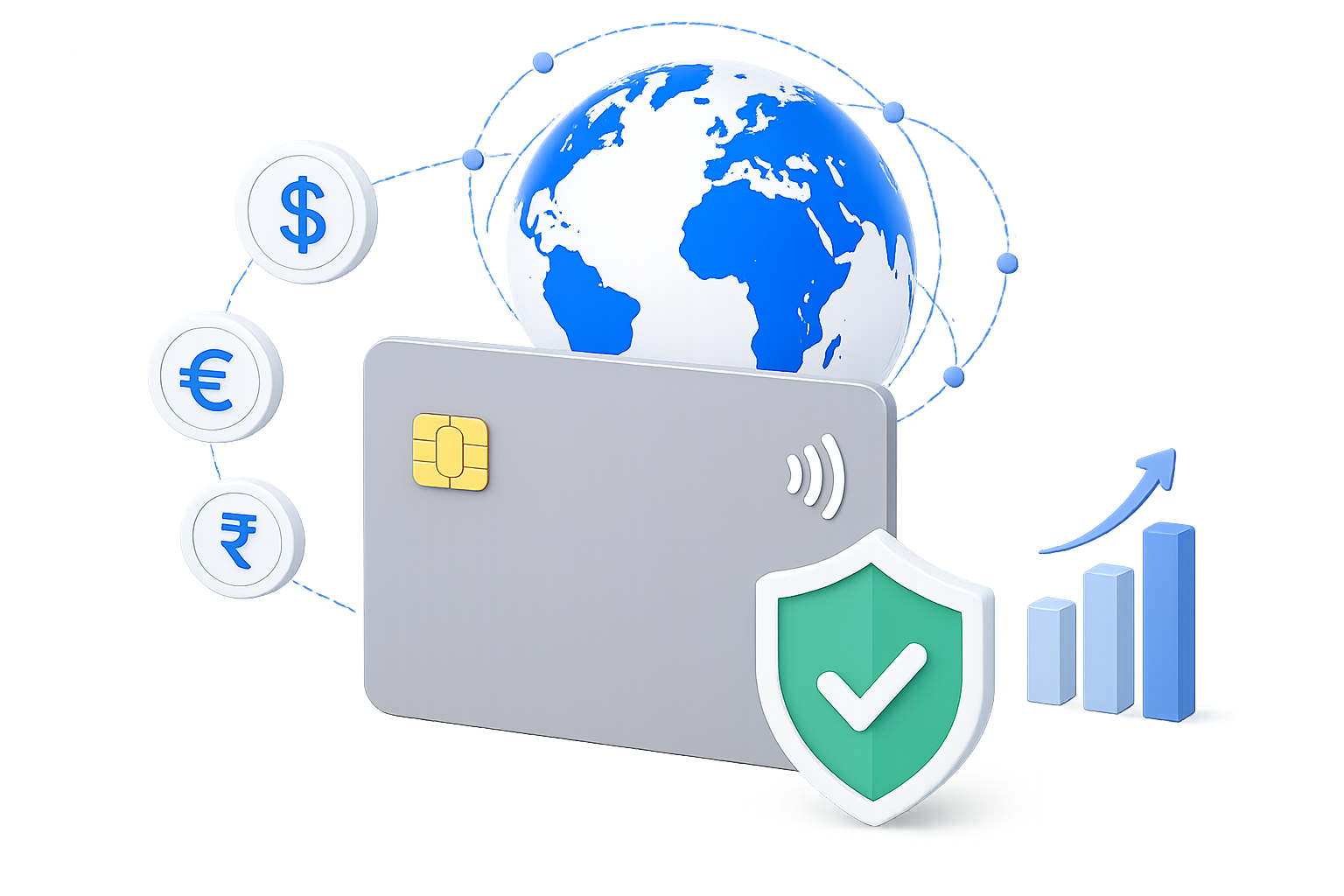
If your business is scaling internationally, PayGlocal's card payments are built for exactly this: high approval rates on foreign cards, settlement in INR, and FIRA issued automatically.
Common mistakes to avoid
A few avoidable errors quietly cost Indian businesses their best international sales:
- Choosing a provider on headline price alone, then losing far more to declined payments.
- Using a domestic gateway for foreign cards and accepting a low approval rate as normal.
- Letting the 3DS step break on mobile, where much cross-border traffic now sits.
- Ignoring settlement and FIRA until compliance or accounting becomes a scramble.
- Treating a low Payment Success Rate as fixed, when it is the single most improvable number in the whole flow.
Ready to accept international cards well?
If foreign card declines are costing you sales, the fix is a gateway built for cross-border approval. Talk to PayGlocal about lifting your Payment Success Rate on international cards, with settlement in INR and FIRA handled for you.