
It is easy to treat "invoice" and "bill" as the same word. In day-to-day speech they almost are. But in accounting they do different jobs, and mixing them up can muddle your records, your payment terms, and even your ability to chase a late payment.
Say a customer at a restaurant hears "please pay the bill before you leave." A little later, a design freelancer emails a client "your invoice for last month's work is attached." Both are asking for money. Neither means quite the same thing.
This guide sets out the difference between an invoice and a bill, what each one should contain, and when to use which, so your books stay clean and your payments arrive on time.
Say a customer at a restaurant hears "please pay the bill before you leave." A little later, a design freelancer emails a client "your invoice for last month's work is attached." Both are asking for money. Neither means quite the same thing.
This guide sets out the difference between an invoice and a bill, what each one should contain, and when to use which, so your books stay clean and your payments arrive on time.
TL;DR
- Invoices and bills serve different purposes: An invoice is a formal request for payment with agreed credit terms, while a bill is usually issued for immediate payment and acts as proof of a purchase.
- Knowing when to use each keeps your accounts accurate: Learn the key differences, what details each document should include, and how they affect payment tracking, accounting, and record-keeping.
- For exporters, invoices play a bigger role: Beyond requesting payment, export invoices support cross-border transactions, foreign payment reconciliation, and documentation such as FIRA.
What is an invoice in accounting?
An invoice is a document a seller sends to a buyer to request payment for goods or services, typically after delivery and with a set due date. It usually gives the buyer time to pay under agreed terms, such as Net 30 (payment due within 30 days).
Invoices carry more detail than a casual bill. They list the amount owed, the payment terms, a due date, and a unique invoice number so both sides can track the transaction over time.
Here is the outcome that matters: a clear invoice sets a shared expectation of when and how you will be paid, and it gives you a dated, numbered record if you ever need to follow up. For any business selling on credit, that record is what keeps cash flow predictable.
For example, an exporter who ships an order raises an invoice that spells out the products sold, the total due, and the terms, say 30 days. That single document formalises the sale and starts the payment clock.
What is a bill in accounting?
A bill is a document that states money is owed for goods or services already received, and is usually due immediately. It is handed to the customer after the product or service has been provided, and it names the amount to be paid.
The restaurant is the everyday example. You finish your meal, the server brings the bill, and you settle it before you leave. In business, a bill works the same way: it is a request for payment that is expected to be paid on the spot or within a short window.
From the receiver's side, a bill is proof of a purchase you have made. When your business buys something and the supplier hands you a bill, that bill sits in your accounts payable (the money your business owes to others).
Invoice vs bill: what is the difference?
The short version: an invoice is a seller's formal, numbered request for payment, often on credit, while a bill is what a buyer receives as proof of a purchase that is usually due right away. They sit on opposite sides of the same transaction.
The table below lays out the practical differences.
| Aspect | Invoice | Bill |
|---|---|---|
| Unique identifier | Has a unique invoice number for tracking and accounting | Usually has no unique tracking number |
| Payment terms | Often credit-based, so the buyer can pay later (e.g. Net 30) | Typically due immediately on delivery |
| Purpose | Sent by a business to request payment from a customer | Received by a buyer as proof of a transaction |
| Legal standing | A legal document that can support financial reporting and debt recovery | Not usually treated as a formal legal document |
| Payment timing | Allows delayed payment under agreed terms | Requires payment at the time of the transaction |
| Common context | B2B and credit sales | B2C and cash-based purchases |
One way to remember it: you *issue* an invoice when you sell, and you *receive* a bill when you buy. Same money, opposite ends of the deal.
What should an invoice include?
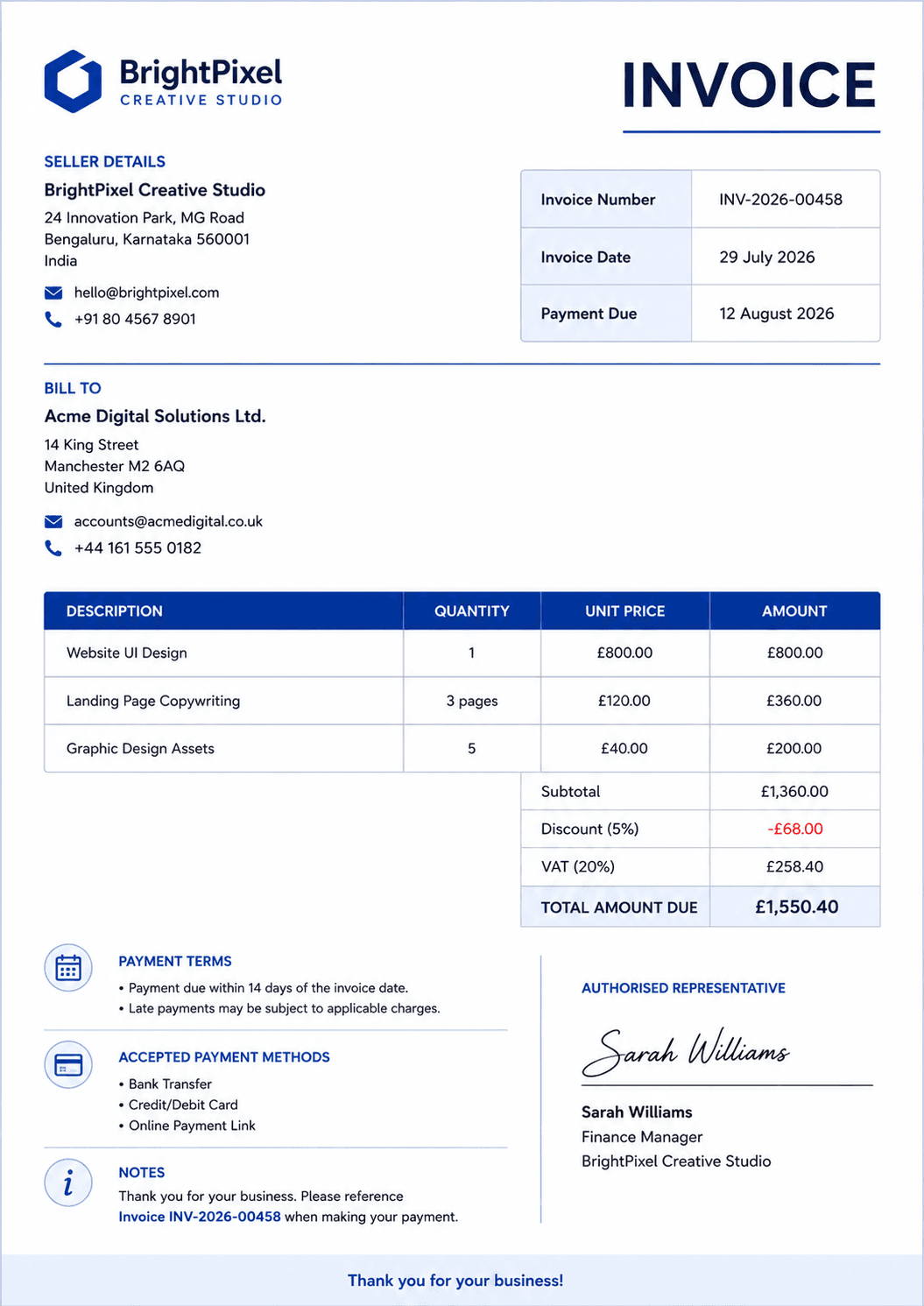
An invoice has to be complete enough to stand as a formal record, so it carries a little more than a bill. Include:
- The word "Invoice", clearly visible
- Seller's name, address, and contact details
- Buyer's name, address, and contact details
- A unique invoice number
- Invoice date
- Description of the goods or services provided
- Quantity and price of each item or service
- Applicable taxes, discounts, or fees
- Total amount due
- Payment terms and due date
- Accepted payment methods
- The seller's signature or that of an authorised representative (optional)
What should a bill include?
A business bill should carry enough detail to be paid quickly and recorded cleanly. At a minimum, include:
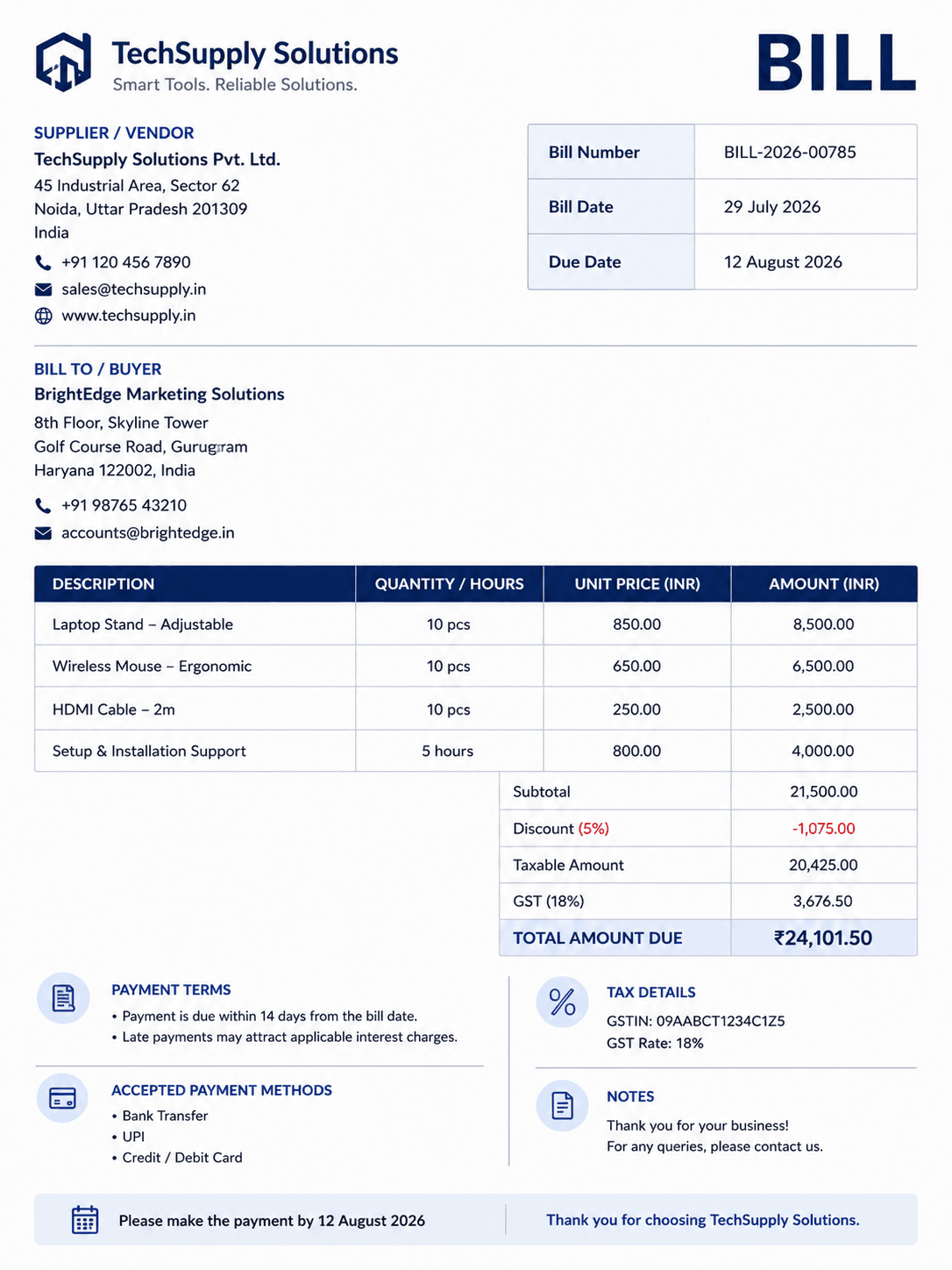
- Supplier or vendor name and contact details
- Bill date
- A unique bill number for tracking and record-keeping
- Description of the goods or services provided
- Quantity of items or hours worked
- Unit price and total amount owed, with or without tax
- VAT or GST percentage, where it applies
- Payment terms, including due date and accepted payment methods
- Any discounts or credits applied
- Buyer or recipient contact details
When should you use an invoice vs a bill?
Use an invoice when you are the seller requesting payment; expect a bill when you are the buyer confirming a purchase. A few factors decide which document fits.
Type of transaction. Selling goods or services? Issue an invoice. Buying them? You will usually receive a bill from the supplier. The invoice requests payment for what you sold; the bill confirms what you bought.
Timing. A bill lands once goods or services change hands and asks for payment more or less on the spot. An invoice is issued after delivery too, but it gives the buyer an agreed window to pay.
Legal and financial weight. Invoices are formal documents that can support debt recovery if payment is late. Bills mainly evidence an immediate obligation and help you manage day-to-day purchases.
Industry norms. Practice varies. Healthcare tends to run on bills for medical expenses due quickly. A business exporting goods issues invoices that detail the shipment, the total due, and the terms, so the payment request is formal and time-bound.
Invoices in cross-border trade
For an Indian business selling to customers abroad, the invoice does more than request payment. It is the formal record that ties an export order to the foreign payment that eventually settles into your bank account, and it underpins the paperwork that follows, including the FIRA (Foreign Inward Remittance Advice, the proof that an inward foreign payment has been received).
That is where getting paid across borders gets its own set of questions: which currency to invoice in, how to give overseas customers a clean way to pay, and how quickly the money settles back home in INR. A clear invoice starts the process; a reliable collection setup finishes it.
PayGlocal is an RBI-authorised cross-border payments platform (authorised by the Reserve Bank of India as a Payment Aggregator - Cross Border - Inward & Outward, PA-CB-I&O, and as an Online Payment Aggregator, PA-O) and part of the ICICI Bank Group. It helps Indian exporters and freelancers collect international payments at a high Payment Success Rate, with FIRA issued automatically after settlement.