
EDPMS, short for the Export Data Processing and Monitoring System, is the RBI platform that decides whether your export proceeds are officially "realised".
Launched in 2014, it creates an entry the moment you file a shipping bill and keeps that entry open until your bank confirms the payment has come back for it. For most Indian exporters, EDPMS is invisible right up until an entry refuses to close, and by then it has become a compliance problem. This guide explains how EDPMS works, where entries get stuck, and how to close them cleanly.
Launched in 2014, it creates an entry the moment you file a shipping bill and keeps that entry open until your bank confirms the payment has come back for it. For most Indian exporters, EDPMS is invisible right up until an entry refuses to close, and by then it has become a compliance problem. This guide explains how EDPMS works, where entries get stuck, and how to close them cleanly.
TL;DR
- EDPMS (Export Data Processing and Monitoring System) is an RBI platform, live since 2014, that tracks every export shipment against the payment realised for it. An entry opens automatically from your shipping bill but does not close until your AD bank matches the incoming payment to it.
- Stuck entries are the real risk. Open entries signal unrealised proceeds and can lead to closer monitoring or an RBI caution list. Clean payment documentation, especially the correct purpose code and FIRA, is what keeps closures routine.
- Remedies exist for genuine cases: invoice value adjustments, realisation period extensions, and write-offs (including a self-write-off backed by a CA certificate), so a payment that cannot be realised on time does not have to become a compliance problem.
What is EDPMS?
EDPMS (the Export Data Processing and Monitoring System) is an online platform the Reserve Bank of India (RBI) introduced in 2014 to track every export shipment against the payment that should come back for it. In plain terms: when you ship goods or file a services invoice, an entry is created, and that entry stays open until your bank confirms the money has arrived. RBI, your bank, and Customs all see the same record.
For an Indian exporter, EDPMS is the system that decides whether your export proceeds are officially "realised". Get it right and closures are routine. Ignore it and open entries pile up, which is what eventually lands a business on a caution list.
EDPMS matches two things: what you shipped (the shipping bill or SOFTEX form) and what you were paid (the inward remittance). When they match, the entry closes.
Why EDPMS matters to you as an exporter
Every export you make creates an obligation to bring the payment back into India within the timeline RBI sets. EDPMS is how that obligation is monitored. An entry that never closes is a red flag against your name, not just a paperwork gap.
The catch most first-time exporters miss: the entry is created automatically from your shipping bill, but it does not close automatically. Someone, usually your authorised dealer (AD) bank, has to match your incoming payment to that specific shipment. If your payment arrives without the right reference, or through a channel your bank cannot reconcile, the entry can stay open even though you have been paid.
How does EDPMS work?
EDPMS runs five core functions. Together they turn a manual, paper-heavy reconciliation into a tracked digital flow:
- Data collection. Banks pull shipping bills and SOFTEX forms (the declaration for software and services exports) from Special Economic Zones (SEZs), Software Technology Parks of India (STPIs), and Customs.
- Data integration. Entry records from different ports are consolidated so nothing is missed.
- Data comparison. The system cross-checks your export data against the inward remittance records to confirm the payment matches the shipment.
- Real-time tracking. Shipment and realisation status update as they change, so exporters and banks are not working off stale files.
- Efficiency. Automating the match speeds up closures and any linked export benefits.
*Also read: [A complete guide to Letters of Undertaking (LUT) for exporters](#) and [Import-Export Code (IEC) explained](#).*
The EDPMS process, step by step
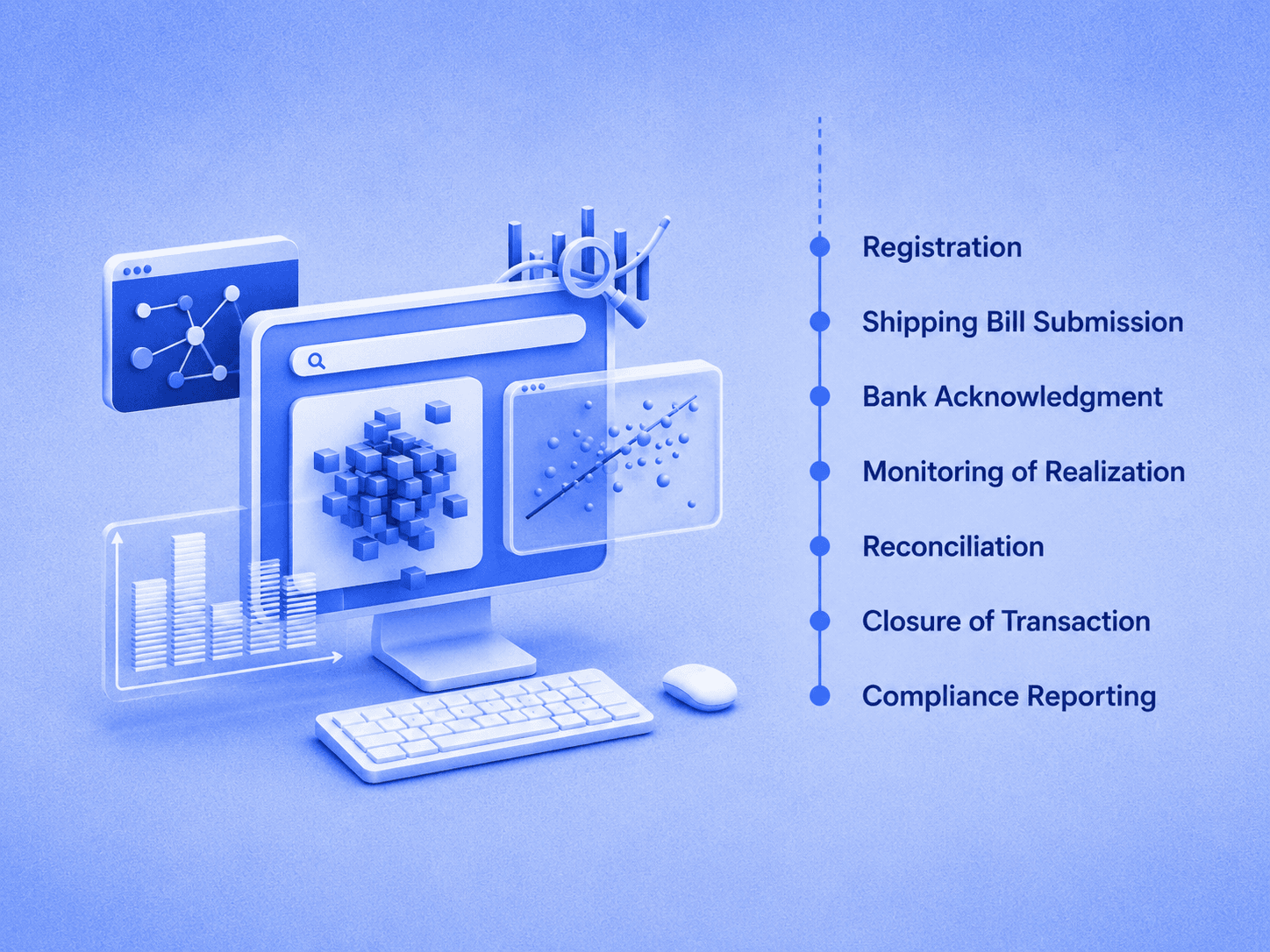
Here is what actually happens to a single export, from registration to closure:
- Registration. You register on the EDPMS portal through your bank, with your IEC (Import-Export Code), bank details, and authorised-personnel information.
- Shipping bill submission. You file the shipping bill with Customs, and it is transmitted to EDPMS.
- Bank acknowledgment. Your AD bank acknowledges the export documents and updates EDPMS with the details, including expected proceeds.
- Monitoring of realisation. The bank tracks whether the payment arrives and updates the system.
- Reconciliation. The bank matches the shipping bill against the realised proceeds.
- Closure. Once the money is realised and matched to the shipment, the entry is closed.
- Compliance reporting. You and your bank generate the reports RBI needs from EDPMS.
The single point of friction in that list is step 5. Reconciliation only works if the incoming payment carries the right purpose code and can be tied to the shipment. A payment gateway that issues clean documentation, including FIRA (Foreign Inward Remittance Advice, your proof that foreign money came in), makes this step routine instead of a monthly chase.
Common EDPMS problems, and how to avoid them
Most EDPMS trouble is not exotic. It comes from four recurring issues:
- Data entry errors. A wrong figure or reference creates a mismatch the system cannot resolve on its own.
- Technical glitches. System failures can delay updates and, briefly, muddy the record.
- Incomplete information. Missing details stall processing and force rework.
- Regulatory compliance gaps. Miss a reporting standard and your records read as inaccurate, which makes monitoring harder for everyone.
The practical takeaway: the cleaner and better-referenced your incoming payment, the fewer of these you ever see. Reconciliation-ready documentation at the point of collection is the cheapest insurance against a stuck entry.
What EDPMS does for exporters and the RBI
EDPMS is a monitoring system, but it does genuine work for the people it monitors:
- Smoother trade operations. Automating the reporting cuts the manual load on every export.
- Ease of doing business. A simpler reporting path is one reason India's export compliance is less painful than it was pre-2014.
- Accurate data for RBI. The regulator gets timely, reliable data on export bills, which is how the wider system stays honest.
- Remittance tracking. Floating foreign-currency remittances are accounted for, so discrepancies surface early.
- Forex management. Cleaner data means better transparency in the foreign exchange market and more stability in it.
How entries are monitored: caution lists and compliance
EDPMS is also the RBI's enforcement lens. A few procedures matter to any exporter:
- Caution list. Exporters with a poor realisation record, compliance history, or open investigation can be added to a caution list for closer monitoring.
- AD bank recommendations. Your bank can flag actions to RBI's Foreign Exchange Department based on how your account behaves.
- Agency collaboration. For non-compliance, EDPMS data can be shared with enforcement agencies such as the CBI, DRI, and Enforcement Directorate.
- Handling non-compliant exporters. The system supports action against exporters who make no genuine effort to bring proceeds back.
- De-caution-listing. Once you comply, there is a defined process to come off the caution list and resume normal operations.
None of this is a threat if your entries close on time. It is a problem only when they do not.
Remedies when an entry will not close
Sometimes a payment genuinely cannot be realised in full, or on time. EDPMS has built-in remedies, and knowing them keeps a stuck entry from becoming a compliance problem:
- Invoice value adjustment. Your bank can approve a reduction in invoice value for a genuine reason, such as a discrepancy or a post-shipment adjustment.
- Realisation period extension. RBI can grant more time to realise proceeds when the delay is genuinely outside your control.
- Write-off. Where proceeds cannot be realised, there is an established process to write off the export bill and clear it from your books.
- Self-write-off. Under certain conditions you can self-write-off a bill with a Chartered Accountant (CA) certificate, without prior RBI or bank approval.
If you use the self-write-off route, the CA certificate must include: export realisation status, amounts written off, Export Declaration Form (EDF) details, original invoice value, commodity description, country of export, and any export benefits surrendered.
The bottom line
EDPMS is not the enemy. It is the ledger that proves you did what an exporter is supposed to do: ship, get paid, and bring the money home. The exporters who never think about it are usually the ones whose collections reconcile cleanly in the first place.
That is where your payment setup earns its keep. PayGlocal settles your international collections in INR to your Indian bank account and issues FIRA automatically on settlement, so the proof your bank needs to close an EDPMS entry is generated for you, not chased after the fact.